Does a Bigger AC Unit Actually Cool Your Home Faster?
November 5, 2026
The Bigger-Is-Better Assumption and Why It Backfires
More power means better performance — that logic works for a lot of things. Air conditioners are not one of them. Oversizing is one of the most persistent and costly installation mistakes in the HVAC industry, and it is driven almost entirely by the intuition that a unit with more capacity is a safer choice. It is not.
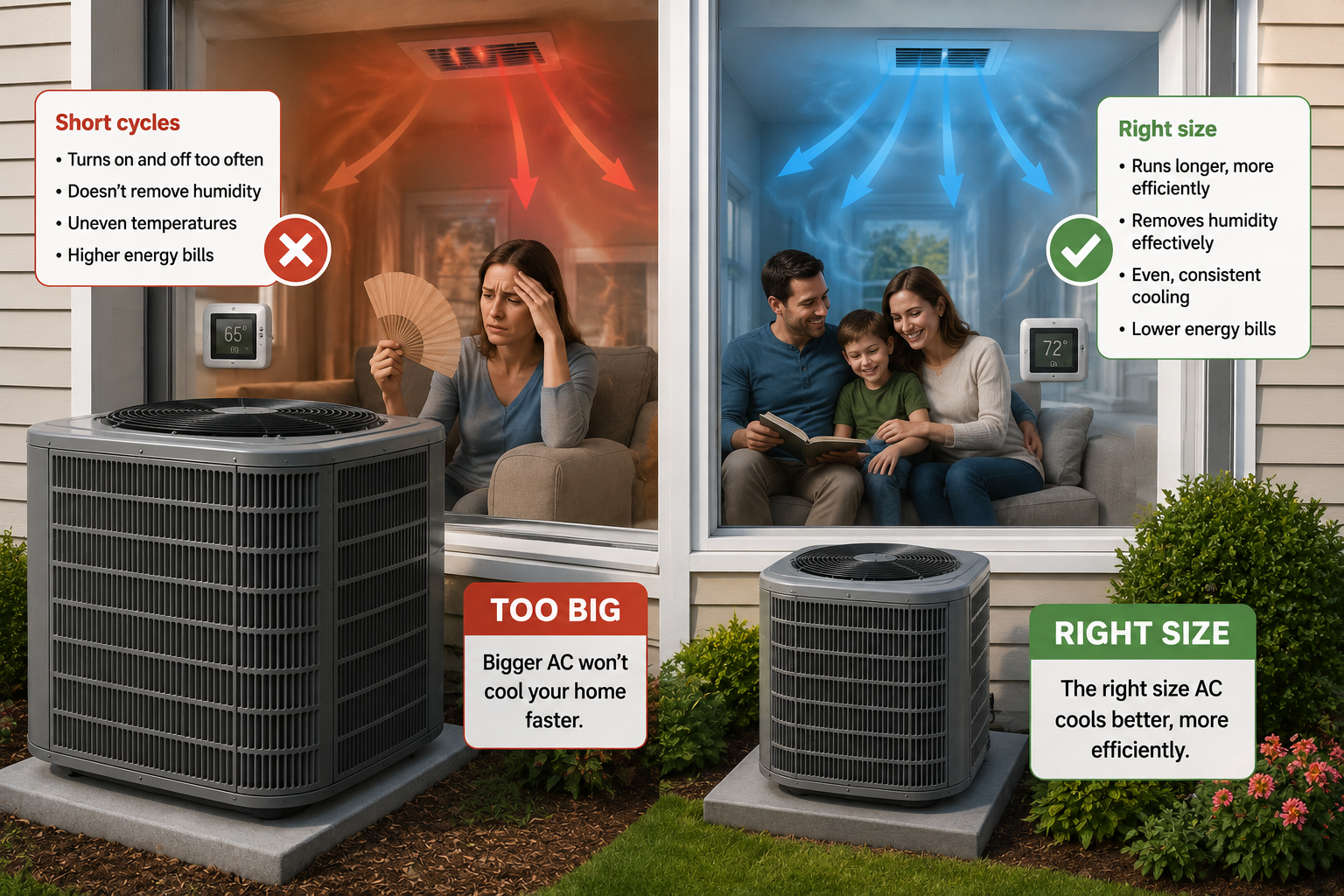
A unit that is too large for your Salt Lake City, Utah home does not cool it better. It cools it incorrectly — in short bursts that leave the air humid and uncomfortable, accelerate equipment wear, and drive energy bills higher than a correctly sized system would. Understanding why this happens makes the case for proper sizing immediately clear.
What Cooling Capacity Actually Does
Air conditioners are sized in tons of cooling capacity, where one ton equals 12,000 BTUs of heat removal per hour. A correctly sized system for your home runs in cycles of 15 to 20 minutes — long enough to remove heat from the air and, critically, to pull meaningful moisture out of it. That dehumidification process is what makes conditioned air feel comfortable, not just the temperature number on the thermostat.
When a unit is oversized, it reaches the thermostat's set temperature in five to eight minutes. It shuts off before completing a proper dehumidification cycle. The temperature then rebounds, the unit kicks on again, and the cycle repeats continuously. This short cycling pattern is the source of every problem that follows from oversizing.
The Real Problems an Oversized Unit Creates
Short cycling causes a cascade of issues that affect comfort, operating costs, and equipment longevity. Each one has a direct impact on the homeowner's experience and wallet.
The Air Feels Humid Even When the Temperature Is Met
The thermostat reads 72 degrees, but the home feels clammy. This is the most common complaint from homeowners with oversized systems. Because the unit never completes a proper dehumidification cycle, moisture remains in the air even after the temperature target is satisfied. In Salt Lake City, Utah, this problem compounds during monsoon-influenced summer humidity events in July and August.
Energy Bills Are Higher Than They Should Be
Starting and stopping uses significantly more electricity than steady operation. A compressor at startup draws its highest current load — and an oversized unit triggers that high-draw startup event far more frequently than a properly sized one. The result is a higher monthly electricity bill despite shorter run times, the opposite of what oversizing is supposed to achieve.
The Compressor Wears Out Faster
The compressor is the most expensive component in an air conditioning system, typically running $1,500 to $2,500 to replace. It wears primarily at startup — the moment of highest mechanical and electrical stress. A properly sized system in Salt Lake City, Utah might start its compressor ten to fifteen times per day. An oversized unit in the same home may start it thirty to forty times. That accelerated cycling shortens compressor life significantly.
Temperatures Become Uneven Throughout the Home
Short cycles cool the area around the thermostat quickly while leaving distant rooms warmer. The thermostat satisfies and the system shuts off before conditioned air has distributed through the full duct network. Multi-level homes and homes with long duct runs — common in Salt Lake City's older neighborhoods — are particularly vulnerable to this pattern.
How Proper AC Sizing Is Done
Sizing an air conditioner correctly requires more than a square footage estimate. The professional standard is a Manual J load calculation, which accounts for every factor affecting your home's cooling demand. Here is how that process works.
- Measure the conditioned space — total square footage across all cooled areas, including ceiling heights for volume calculations.
- Assess the building envelope — insulation levels in walls, attic, and floors; window area, type, and orientation; air infiltration rates.
- Apply local climate data — Salt Lake City, Utah has specific design temperatures for sizing calculations, accounting for peak summer heat in the valley.
- Factor in internal heat gains — occupant count, appliances, lighting, and any unusual heat sources specific to the home.
- Calculate duct efficiency — leaky or undersized ductwork reduces the effective capacity of the system and must be factored into the equipment selection.
- Select equipment within the calculated range — a 10 percent margin above ideal is acceptable; significant oversizing is not.
Signs Your Current System Is Oversized
If you are experiencing any of these patterns consistently, oversizing is worth investigating with a licensed technician.
- Cooling cycles run fewer than ten minutes before the unit shuts off
- The home feels humid even when the thermostat is satisfied
- Energy bills are higher than neighbors with similar-sized homes
- Certain rooms never feel as comfortable as the room containing the thermostat
- The system has had compressor or electrical issues despite being relatively ne
Frequently Asked Questions
Is a slightly oversized unit ever acceptable?
Minor oversizing — around ten percent above the calculated ideal — has limited practical consequences and falls within the acceptable margin most HVAC engineers recognize. It is significant oversizing, 25 percent or more above ideal, that creates the short cycling, humidity, and wear problems described in this article. The issue is that many older installations used rough square footage estimates that produced oversizing well beyond that threshold.
Can a bigger AC unit cool my home to a lower temperature than a smaller one?
No. Both units can only cool to whatever temperature you set on the thermostat. A larger unit reaches that set point faster, but it shuts off with humidity still in the air — often leaving the home feeling less comfortable at the set temperature than a properly sized system would after completing a full dehumidification cycle.
Does undersizing create the opposite problem?
Yes. An undersized unit runs continuously in peak heat without reaching the set temperature. This also causes high energy consumption and accelerated wear, but through continuous operation rather than excessive cycling. Neither undersizing nor oversizing is acceptable — the goal is a correctly matched system.
What if my ductwork is the real problem?
Leaky, undersized, or poorly configured ductwork can create hot spots and inadequate distribution that look like undersizing to a homeowner. Some contractors address this by recommending a larger unit — which compounds the problem rather than solving it. Always have ductwork inspected before replacing or upsizing the system. Duct sealing or modification is often the more appropriate and less expensive fix.
How much does a Manual J calculation cost on its own?
Reputable HVAC contractors performing a replacement quote include the load calculation at no additional charge. As a standalone service, it typically runs $100 to $300. It is always worth requesting. If a contractor proposes sizing based on square footage alone without performing a calculation, that is a reason to seek a second opinion before committing to any equipment purchase.
Right-Sized Is Always Better Than Big
The counterintuitive reality of air conditioning is that a correctly sized system outperforms a larger one on every measure that matters — comfort, humidity control, energy efficiency, and equipment longevity. In Salt Lake City, Utah, where summer heat demands genuine cooling performance, a properly matched system delivers what an oversized one promises but never delivers.
Every replacement system
Hill Heating & Air installs begins with a load calculation. If you are replacing an older unit, experiencing comfort issues with an existing system, or want to know whether your current equipment was sized correctly,
reach out for an assessment. Sizing right at the start is one of the most important decisions in any HVAC installation.